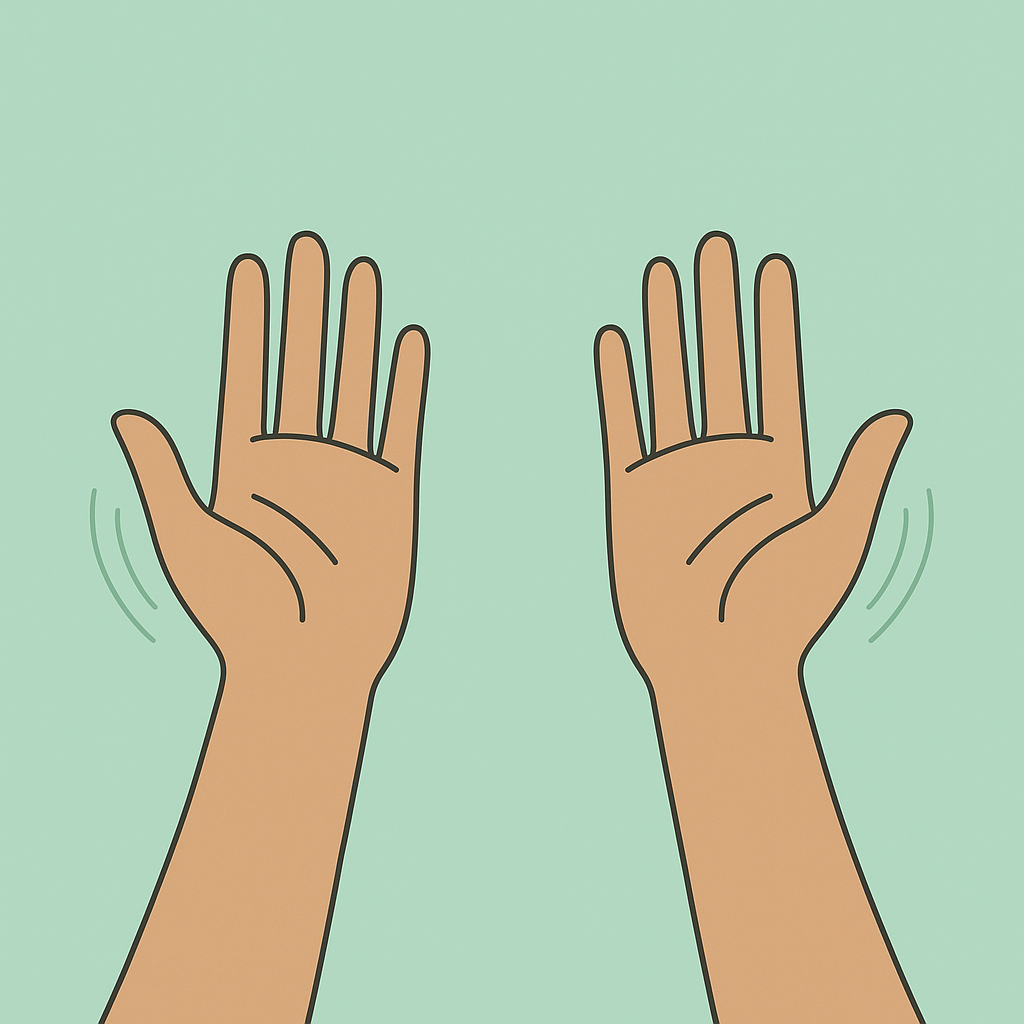
Hands do more than wave hello—they quietly broadcast how we feel. New research from Birkbeck shows that people read emotion more accurately when they see both hands in their natural positions, not a single hand or a distorted pair. Why? Our brains seem to process the shape of each hand and the spatial relationship between them as one holistic cue. That two-hand view especially boosts recognition of fear and anger. For parents, teachers, and therapists, it’s a reminder: when words falter, open, congruent hands can support safety and understanding. Our gestures aren’t extras; they’re core to how humans connect. You can read more at the British Psychological Association.
Here is something you can put into practice:
7-Day “Two-Hand Check-In”
Why: Your hands quietly mirror your emotions. Seeing and gently adjusting both hands can help your body feel safer and clearer.
Time: 3–5 minutes, 1–2x/day
What you need: A chair, a notepad (or phone notes), and your hands.
Step-by-step (PALMS)
- Pause – Take one slow breath and look at both your hands.
- Assess – Notice each hand’s shape (open/closed), tension, and position relative to each other (same height? pulled in? pushing away?).
- Label – Name an emotion (even a guess): calm, sad, afraid, angry, mixed. Rate intensity 0–10.
- Match – Ask: Do my hands match how I want to feel right now?
- Soften – Adjust to “safe hands”: palms visible, roughly equal height, fingers loose, movements slower for 20–30 seconds. Re-rate intensity.
Tiny experiments (pick one)
- Lower & Level: Gently bring both hands to belly button height, same level.
- Uncurl: If clenched, uncurl fingers 10% at a time.
- Together-Apart: Slowly bring hands closer, pause, then apart—notice which feels safer.
Quick log (jot one line)
- Before: Emotion and rate from 0–10. Hand posture word (e.g., clenched high)
- After: Emotion and rate from 0–10. What changed?
Example: Before: fear 7. tight, hands up. After: fear 4. open, level.
When to use
- Before a tough conversation, after a conflict, starting/ending work, or anytime you feel “off.”
Kid/Teen tweak
Make a Hand Meter (0–5):
0 = floppy/resting, 5 = tight/high. Do PALMS to move one step closer to calm.
Safety notes
- Different cultures, backgrounds and histories can give gestures different meanings. Use what feels respectful and safe for you.
- This is information, not a diagnosis. If emotions spike, pause and reach out to a counsellor or to a trusted support.